

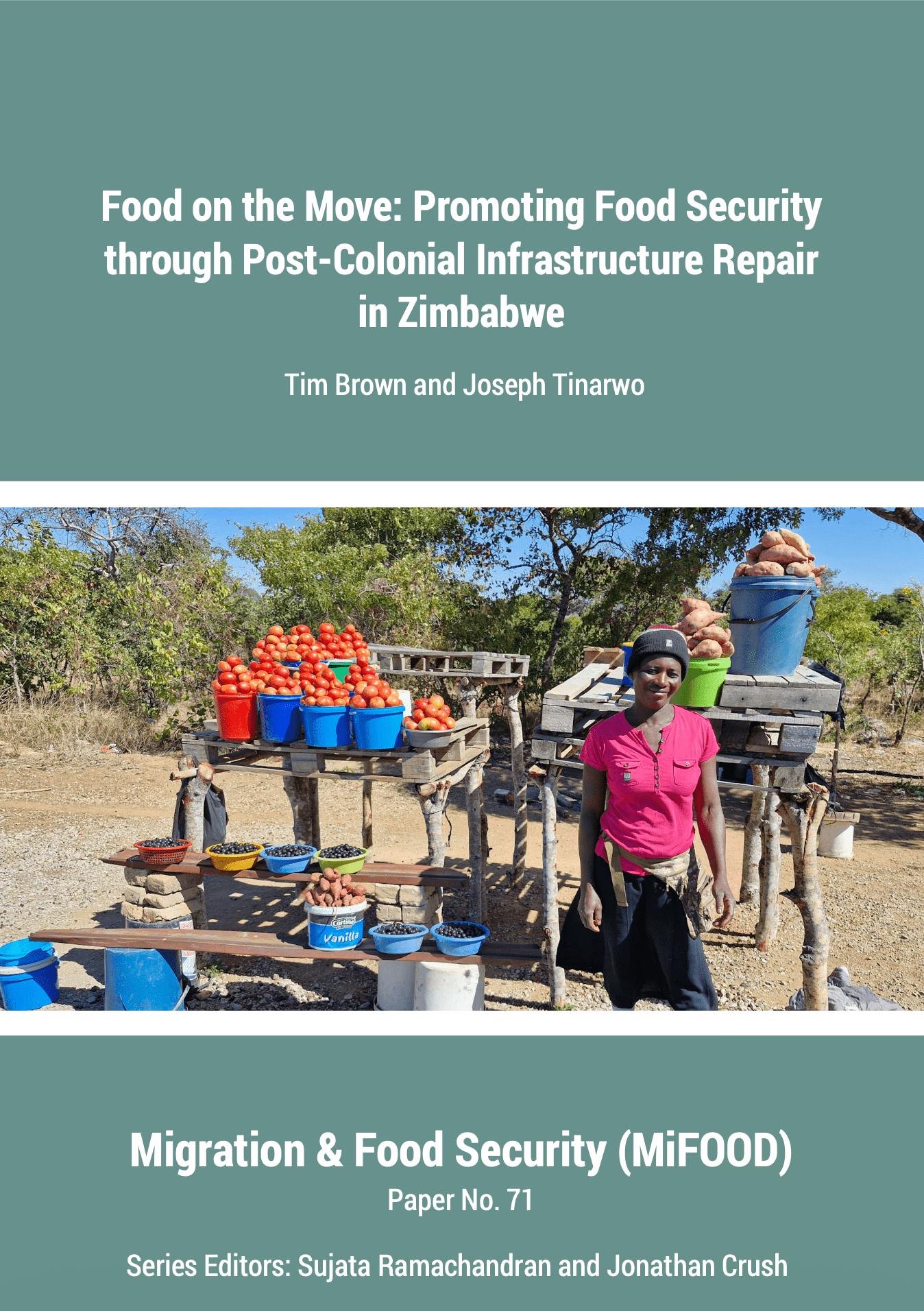
Infrastructure of various types is increasingly recognised as vital to food and nutrition security, especially in urban food systems characterised by informality and off-grid conditions. Drawing on a qualitative approach that combines mobile observation, policy analysis, and semi-structured stakeholder interviews conducted during fieldwork in 2023 and 2024, this paper considers the potential of a transport infrastructure repair programme implemented in Zimbabwe since 2019 to alleviate the country’s ongoing food crisis. A detailed analysis of the national policy context, supplemented by interviews with key stakeholders, identified three overlapping themes central to this: reconstruction, reintegration, and reconnection. As the paper argues, these themes were mobilised to justify the resources allocated to the repair programme, to outline its ambitions for (re)establishing Zimbabwe as a modern, middle-income economy, and to explain how it would promote improvements in food and nutrition security. However, the same themes are also mobilised in the paper as a critique of the enacted programme. As the paper documents, the prioritisation of regional highways and formal transport corridors leaves many rural feeder roads and peri-urban settlements effectively off-grid, reinforcing spatial and temporal inequalities that existed prior to the programme. Roadside informal economies, which function as important forms of vernacular infrastructure, have also been displaced by road modernisation and associated efforts to formalise urban space. Furthermore, improved connectivity facilitates not only the movement of agricultural produce but also the circulation of ultra-processed foods through formal, informal, and increasingly digital networks. The paper argues that transport rehabilitation should therefore be understood as a process that simultaneously enables and constrains food and nutrition security. Effective infrastructure policy requires greater attention to the uneven connectivity across the urban-rural continuum and to the informal infrastructures through which marginalised communities access, distribute, and secure food.
September 8, 2026
MiFOOD Paper No. 71