

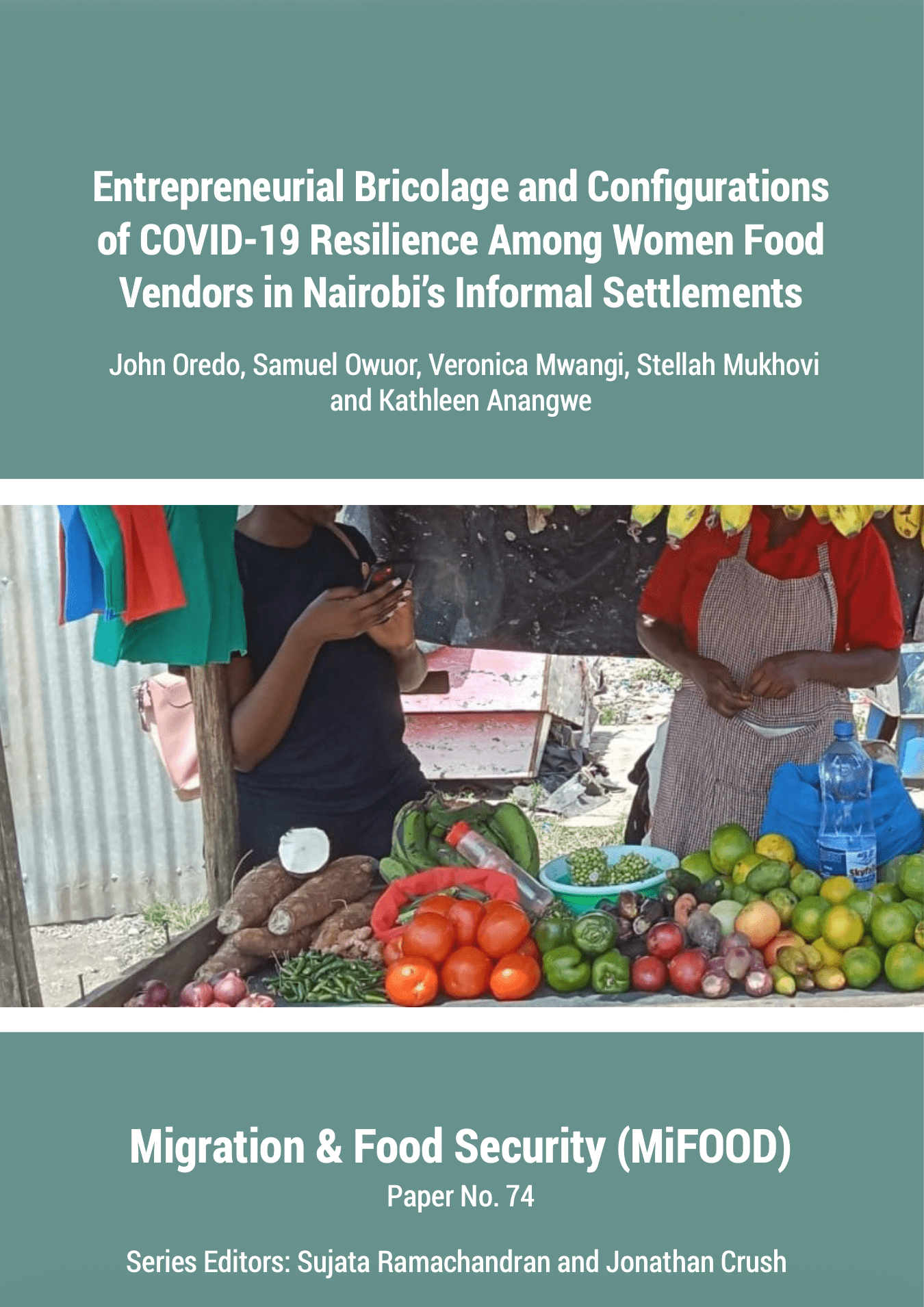
Women food vendors are central to urban informal food systems in Nairobi’s informal settlements. They connect low-in- come households to accessible and affordable food while sustaining their own livelihoods. However, they operate these enterprises under conditions of income precarity, limited capital, unstable demand, food perishability, and constrained urban informality. The COVID-19 pandemic intensified these vulnerabilities, turning everyday livelihood pressures into acute shocks to household survival and enterprise continuity. This paper examines COVID-19 resilience among women food vendors in four informal settlements in Nairobi. Drawing on entrepreneurial bricolage and a configurational perspective, it investigates how digitalisation, market sensing, resource mobilisation and operational adaptation combined to support recovery from pandemic-related business disruption. Using survey data from 260 women vendors and fuzzy-set Qualitative Comparative Analysis (fsQCA), the study finds that no single condition was necessary for resilience. Instead, the main pathway to resilience was resource mobilisation under conditions of low digital and operational adaptation. This suggests that some women vendors recovered not primarily through digital tools or extensive operational change, but through relational, collective and financial resources such as credit, customer trust, supplier relations, savings groups and peer support. The paper contributes to research on informal food systems, gendered livelihoods, and crisis recovery by showing that resilience is situated, relational, and produced through configurations of everyday practices rather than a single universal pathway.
October 14, 2026
MiFOOD Paper No. 74
Featured City: Nairobi, Kenya