

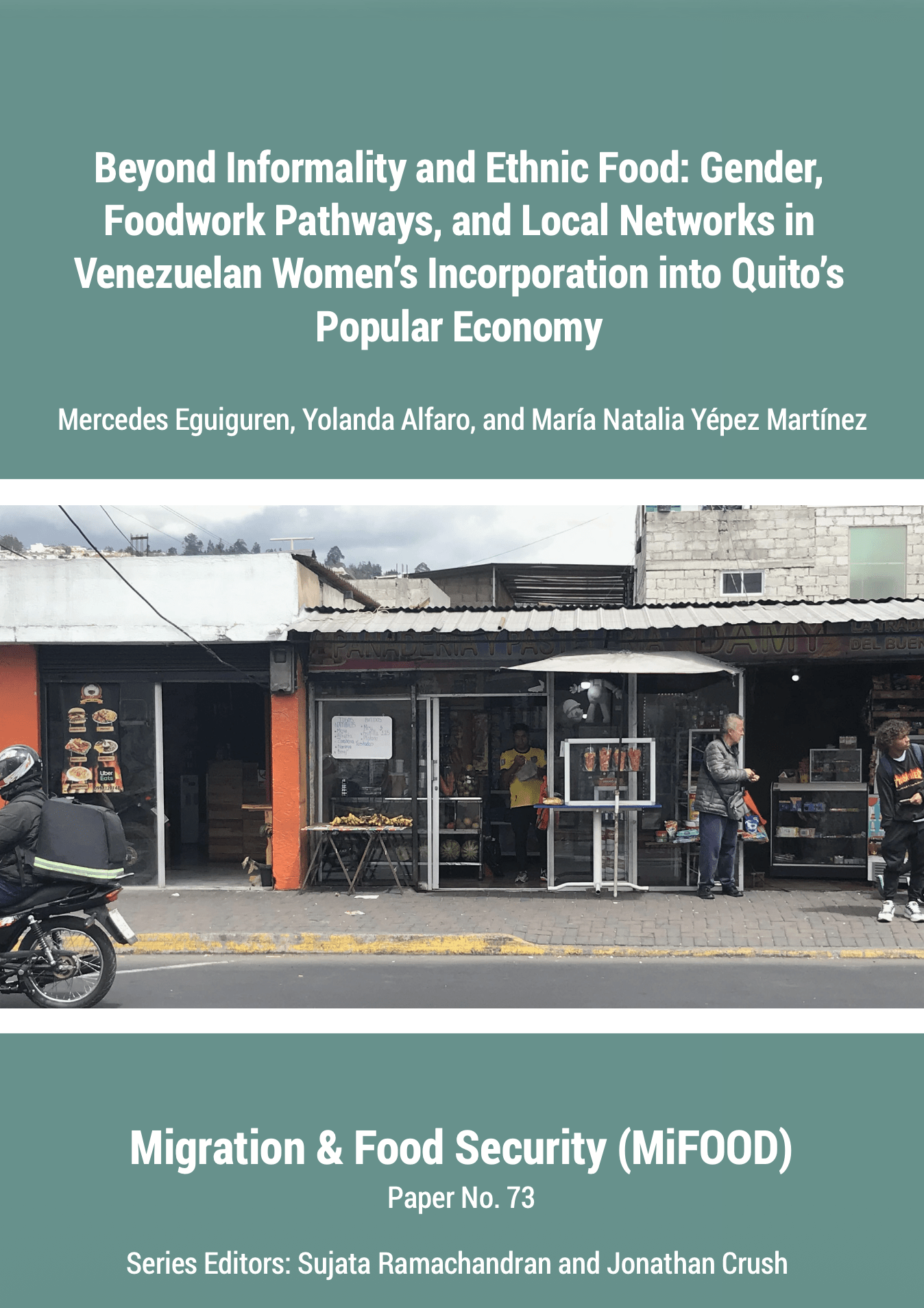
This paper examines how Venezuelan migrant women become incorporated into Quito’s urban food economy through small-scale food businesses. Drawing on 21 semi-structured interviews in the Carapungo neighbourhood of Quito, Ecuador, we adopt a trajectory-based approach informed by scholarship on the popular economy, gender, and migration. We argue that these businesses cannot be understood solely as products of informal labour-market structures or as strategies of cultural reproduction. Our findings show how they emerge at the intersection of women’s migration and labour trajectories and care responsibilities, and how they are built and sustained through the mobilisation of food-related knowledge and skills and social and institutional networks. Our study also questions reified associations between migration, ethnic food, and culture. Rather than simply reproducing a fixed culinary heritage through ethnic food, women draw on and develop varied culinary repertoires before and after migration, adapting them to local conditions and tastes. The study contributes to research on the contemporary shaping of informal urban economies in Latin America by revealing situated processes of migrant incorporation into urban popular economies.
October 14, 2026
MiFOOD Paper No. 73
Featured City: Quito, Ecuador