

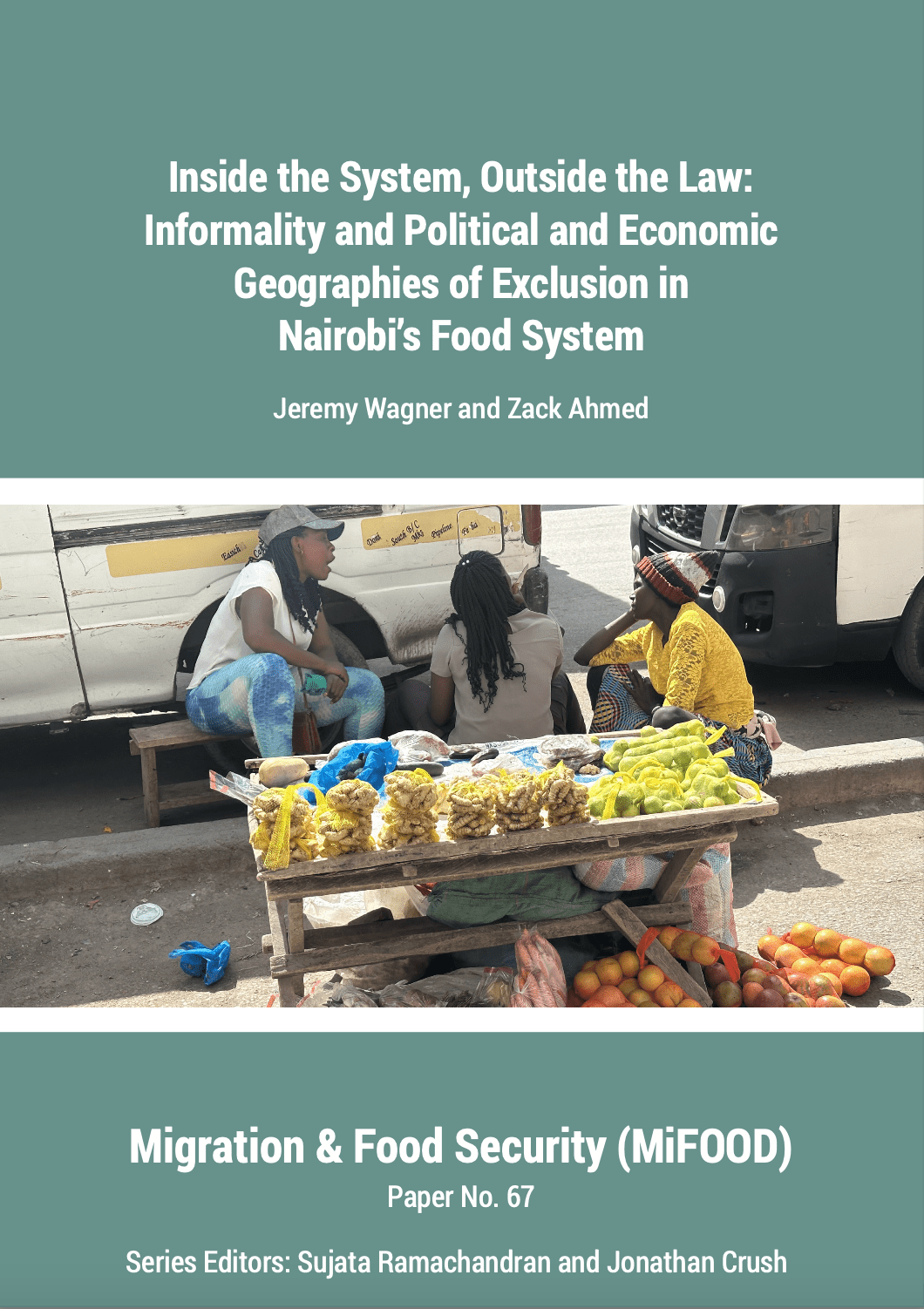
Rapid urbanisation across sub-Saharan Africa is reshaping urban food systems and shifting the geography of food insecurity from rural to urban areas. Using Nairobi, Kenya, as a case study, this paper examines how governance systems reproduce political and economic geographies of exclusion for the informal economy within a rapidly transforming urban food system. Drawing on systems thinking, stakeholder mapping, and empirical data from the Hungry Cities Partnership household and informal food vendor surveys, the paper argues that informal food economies are not transitional sectors destined to disappear through modernisation, but structurally embedded components of Nairobi’s food system that sustain food access, employment, and urban survival. Through an analysis of five dominant myths surrounding informality, the paper demonstrates that formalisation agendas and narratives of supermarket modernisation continue to marginalise informal food actors despite their central role in sustaining urban food security. These exclusions arise not simply from policy failures but from interconnected governance structures, institutional assumptions, and development priorities that privilege formalisation while relying on informal labour and distribution systems. The paper concludes that the challenge facing rapidly urbanising African cities is not how to eliminate informality, but how to govern urban food systems without reproducing exclusion as a condition of survival.
June 12, 2026
MiFOOD Paper No. 67
Featured City: Nairobi, Kenya